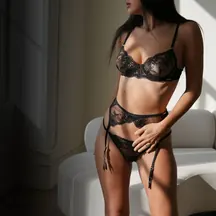
Why this category works as a first step
Lingerie and swimwear sit in a useful middle ground. The images are adult, styled, and intimate, but they do not require full nudity or a complicated set. You can create them at home, with a phone, in light you already have. That makes this category a low-pressure way to learn how a brief works, how a client communicates, and how you feel about your images being used.
It is also a category with steady demand. Lingerie brands need real bodies in real light. Swimwear labels want summer energy in the middle of winter. Private clients want a specific set, a specific mood, or a specific piece they have been thinking about. The requests vary, but the core skill is the same: creating an image that feels intentional rather than staged.
You do not need to look like a catalogue model. You need to look like a person who knows how to hold a frame. That is a learnable skill, not a body type.
What clients actually ask for
The briefs in this category usually fall into a few groups. A small brand may want a set of images for a product page or a social campaign. A private client may want a custom set in a particular colour, fabric, or setting. An artist or mood board may want a specific atmosphere: morning light, a hotel bathroom, a messy bed, a clean minimal wall.
Most requests are specific about the feeling, not the pose. “Soft morning light, no face, black lace” is a useful brief. “Just send something sexy” is not. A good client can explain what the images are for and how they will be used. If he cannot, that is a warning sign, not a creative challenge.
You can decline any element. You can say no to sheer fabric, no to a particular pose, no to showing your face, no to a client whose messages feel off. The category is a menu, not a contract.
What you actually need
You do not need a professional camera, a rented studio, or a perfect apartment. You need a phone with a clean lens, a window, a plain wall or a deliberately styled corner, and one or two pieces you feel good in. A white sheet, a chair, a mirror, and a little patience will do more than an expensive light you do not know how to use.
Natural light is the easiest place to start. Stand near a large window, turn off the overhead light, and check the frame for clutter. A made bed or a clean wall is enough. If you want a more polished look, add one deliberate detail: a plant, a curtain, a piece of jewellery, a colour that repeats in the background.
For the first set, keep it simple. One outfit. One corner. Five to eight images with small variations: close, three-quarter, seated, standing, detail. That is enough to show a client what you can do without turning your home into a production set. The phone photo guide walks through the technical side.
How the process works
You apply with a regular, non-explicit photo and a few honest sentences about what you are open to. If a lingerie or swimwear brief fits, Aurora sends you the brief, the price, the deadline, and the usage terms. You accept or decline. If you accept, you create the set at home and deliver it through a private channel. The client pays, and you receive 75% of the agreed project fee.
The 25% is not a monthly charge. It covers the work that happens before a brief reaches you: finding the client, screening him, clarifying the request, agreeing the price, and handling the admin and payment risk. You can read the full breakdown in how client matching and the 75% split work.
Boundaries and privacy in this category
Lingerie work can be private without being anonymous. You can use a stage name, keep your face out of the frame, choose a background that does not identify your home, and remove location metadata before you send anything. You can also choose to show your face. There is no single right answer.
What you cannot do is promise yourself that nothing will ever be copied. Screenshots exist. Clients can break agreements. Privacy is a set of precautions, not a guarantee. If complete anonymity is non-negotiable for you, this is not the right work. If you want to be careful, we can talk through what careful looks like before you create anything.
Your body is not a customer service desk. You do not have to answer every message, explain every no, or accept a request because someone is persistent. A boundary is not a negotiation.
Who this category suits
It suits adults who are comfortable with lingerie imagery, who can follow a simple brief, and who want a first project that does not require full nudity. It suits people who are willing to learn light and framing, and who can communicate clearly about what they will and will not do.
It does not suit anyone under 18. It does not suit someone who is being pressured, who needs a guaranteed income this week, or who expects every application to turn into paid work. It does not suit someone who wants to remain completely invisible. Those are not moral failings. They are just mismatches with this kind of work.
Questions about lingerie and swimwear work
Do I need to show my face?
No. Many lingerie briefs work without a face, especially if the focus is on the outfit, the light, or a detail. Some clients will ask for a face, and you can decline those briefs. It is better to keep a limit than to break it for one project.
Can I use clothes I already own?
Yes. Your own wardrobe is often better than a cheap outfit bought for one shoot. A piece that fits you well, in a colour you like, will look more natural than something uncomfortable. If a client needs a specific item, the brief should say who provides it and whether it is returned.
How much can I earn from one set?
It depends on the brief, the number of images, the usage rights, and the client's budget. There is no fixed rate and no guaranteed income. The price is agreed before you create anything, and you receive 75% of that agreed fee.
I run a private casting and project-matching service for adult creators. I write about the practical side of the work: money, privacy, boundaries, and the questions women ask before they decide.